
Wedding Seating Chart vs. Escort Cards vs. Place Cards: What's Best for Your Reception?
If you are trying to decide between a wedding seating chart, escort cards, and place cards, you have probably noticed that every wedding site uses these terms a little differently. Some treat them as the same thing. Others tell you that you need all three. Neither is quite right.
Each one solves a different problem, and the one you pick affects how your guests feel in the first ten minutes of your reception. This guide explains what each format does, what it costs, where it falls short, and a newer option that many couples are pairing with a printed sign.
The Quick Answer
Here is the short version before we get into detail.
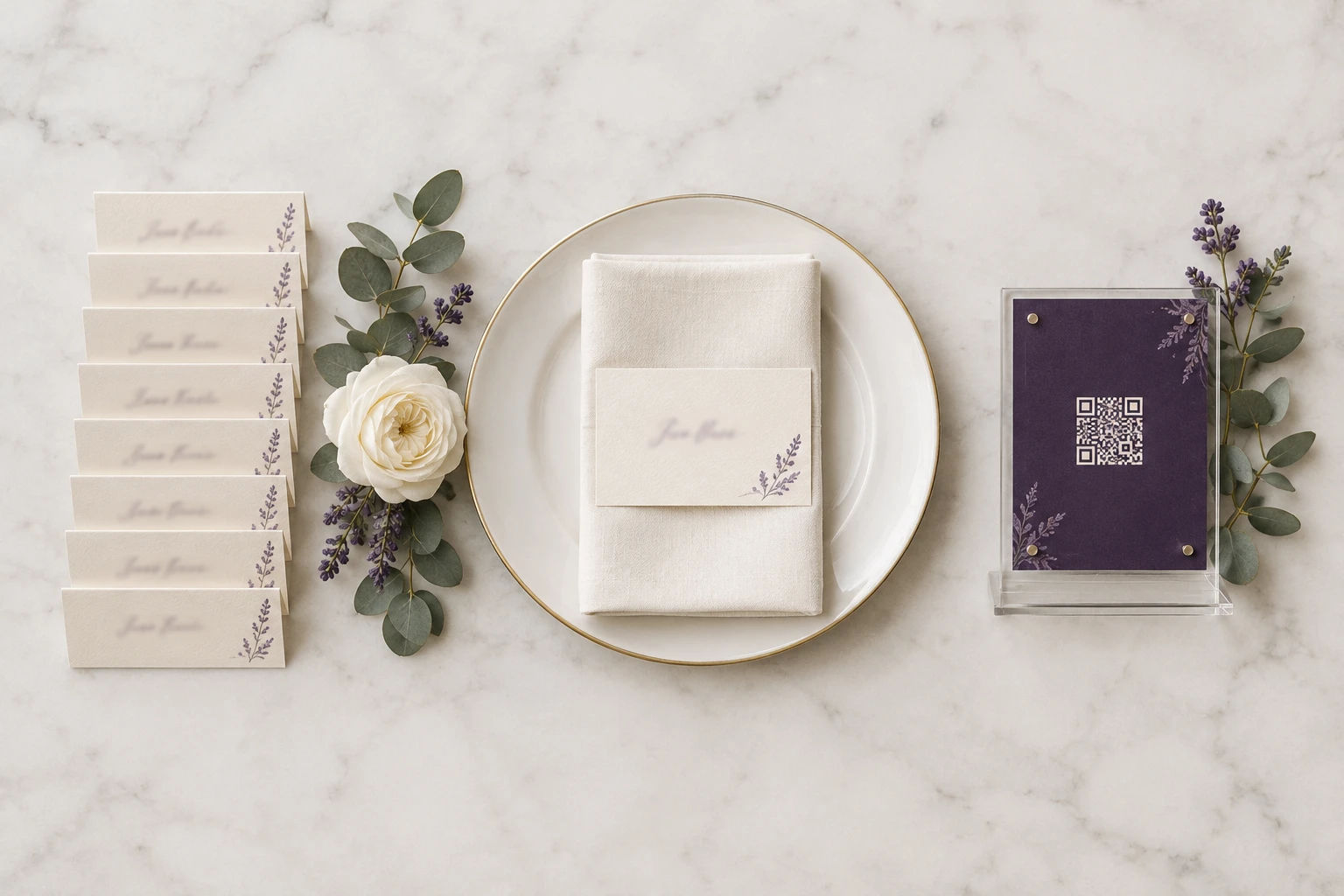
Escort cards tell a guest which table to go to. Each card has a guest name and a table number, and the cards are usually arranged on a table near the entrance. Guests pick up their own card and walk to their table.
Place cards tell a guest which exact chair to sit in. They sit on the table at each setting. A place card does not help anyone find their table, which is why couples who use only place cards still need something at the entrance.
A seating chart display lists every guest and their table in one spot. It might be a poster, a mirror, an acrylic sign, or a framed board on an easel. Guests walk up, scan the list for their name, and then head to their table.
You can use one of these, or combine two. The most common pairing is escort cards plus place cards, which is also the most expensive and the most work.
The Bottleneck Problem
The biggest issue with traditional options has nothing to do with looks. It is about how people move.
When cocktail hour ends and dinner is announced, most guests head for the seating display at the same moment. A single poster or a table of escort cards becomes a pinch point. People stop, lean in, search, and step aside slowly while the next person moves in.
With 60 guests, this barely registers. With 150 or more, it turns into a line, and the line forms in the exact spot where you want people to feel relaxed and looked after.
There are a few reasons it gets worse as guest count grows:
Alphabetical lists are long. A list of 200 names needs small type to fit on a board. Small type is hard to read from a standing position, especially for guests who need reading glasses.
Escort cards get picked over. Cards laid out in rows get shuffled. Someone grabs the wrong one. Someone cannot find theirs and asks the coordinator, who is now busy with something else.
One display serves one person at a time. Even with two posters, the number of guests who can look at the same moment is small compared to the number who arrive at once.
This is the main reason many couples start looking for digital seating chart alternatives. The goal is not to drop a tradition. It is to remove the crowd.
What Each Option Really Costs
The sticker price of paper options looks low, but the total tends to climb. These are typical ranges. Your actual quotes will depend on your region, your printer, and how much design work you want.
Seating chart display. Design can be free if you do it yourself or $50 to $150 with a designer. Large format printing on foam board or a similar material often runs $50 to $200. Add an easel, which you may buy or rent for $15 to $50. A calligraphed acrylic or mirror display can cost several times more.
Escort cards. Most couples print one card per guest or per party. At roughly $0.50 to $3 per card, a 150 card order lands somewhere between $75 and $450. Then add card holders or a display setup, plus the time to sort and arrange them by table.
Place cards. The pricing is similar to escort cards, and the work is more fiddly. Every card must go on the right plate. If you track meal choices with a small symbol or color, you have one more thing to check.
The hidden cost is the reprint. Guest lists change right up to the week of the wedding. Someone cancels. Someone adds a plus one. A table gets reshuffled so two relatives are not seated together. Once the printing is done, every change costs money and time. Rush fees can add $50 or more, and a hand correction on a printed board never looks good.
There is also waste. A foam board or a stack of escort cards is used for a couple of hours and then thrown out.
The Modern Hybrid Option
A third path has become popular over the last couple of years, and it is not a replacement for good stationery. It is a way to keep the pretty parts and drop the crowd.
Here is how it works. You put a stylish welcome sign at the entrance with a QR code on it. Guests scan the code with their phone camera, type their name, and see their table number. That is the whole interaction. No app download, no account.
The host manages the guest list from a dashboard, so changes go live right away. The QR code on your sign never changes, which means you never reprint it, even if you move five people the night before.
Couples who like this setup usually keep one or two physical touches:
A framed or acrylic sign with the QR code, in the same style as your other signage.
Place cards at each seat if you want a personal detail on the table.
Small QR cards on cocktail tables so guests can look up their seat while holding a drink, instead of lining up at the door.
A printed backup list at the welcome table for the few guests who do not use a smartphone, which a coordinator or family member can help with.
DigiSeats is one tool that works this way. You upload a spreadsheet, assign tables, and get a QR code you can print on a sign. There is a free plan for up to 50 guests, and the paid plans start at $49.99 for up to 500 guests. You can try the guest experience yourself with the live demo before you decide anything.
Other platforms offer similar QR lookup, so compare a few. What matters is that guests do not need an app, that you can edit after printing, and that someone answers your email if something goes wrong the week of the wedding.
Side by Side Comparison
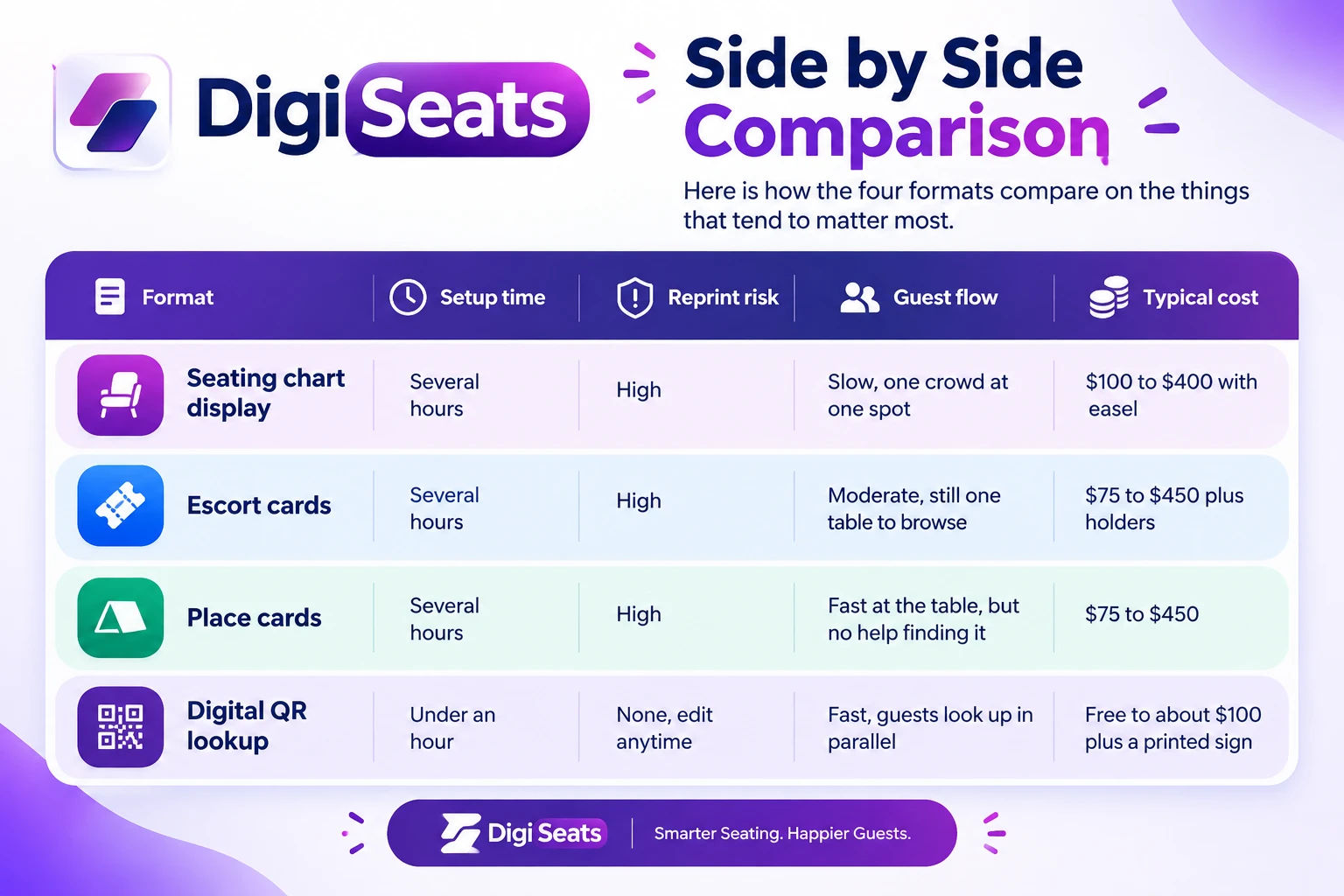
Here is how the four formats compare on the things that tend to matter most.
A few notes on reading this table. Place cards are not a complete solution on their own, because guests still need to find their table. Escort cards solve the table question but not the crowd. A seating display solves neither well at larger sizes. And digital lookup solves the crowd and the reprint problem, but it works best when paired with at least one physical element so the entrance still looks designed.
How to Choose for Your Wedding
The right answer depends on your guest count and how much you care about each detail.
Under 40 guests. A handwritten place card at each seat is plenty. Everyone knows each other, and a digital setup adds little.
40 to 100 guests. Escort cards or a single elegant display work fine. The crowd is manageable. If your list is still changing close to the date, a digital option can save you a reprint.
100 guests and up. This is where the entrance gets crowded, and where reprints get expensive. A QR lookup plus a styled sign solves the two biggest problems at once. Add place cards if you want the extra detail.
Mixed ages and tech comfort. Keep a printed backup list and assign one person to help. It takes five minutes to set up and covers the edge cases.
A calligraphy lover. Keep the calligraphy. Use it for place cards, menus, or a welcome sign. Let the QR code handle the lookup. Many couples find this gives them the look they wanted and takes away the stress they did not.
A Practical Plan
If you are still deciding, this order works for most couples:
Lock your table count and venue layout first.
Decide which physical details matter to you, such as place cards or a framed sign.
Pick one method for the entrance and test it with a few friends.
Freeze the guest list about two weeks out, and keep a short process for late changes.
Print signage as late as you reasonably can, so nothing goes out of date.
None of this has to be complicated. The goal is a calm entrance and guests who sit down a few minutes after they arrive.
Final Thoughts
Escort cards, place cards, and seating displays all have a place. Each one does something specific, and each one has a cost in time, money, and flexibility. The question is which problem you most want to avoid: the entrance crowd, the reprint, or the extra paper.
For smaller weddings, stick with what you love. For larger ones, a QR lookup paired with a good sign usually gives you the best result for the least effort.
Create your digital event seating chart in minutes with DigiSeats.